realisedevelopment.net

Just another WordPress site

Problems With Partnerships

February 25, 2008 by admin

Fellow Leeds blogger Todd Hannula has shared some of his concerns about ‘partnership’ over at his Social Catalyst blog which prompted me to comment.  I think this matters because so often I see partnerships of competent, mature and capable organisations that  in ‘partnership’ become the corporate equivalent of  a three year old having a temper tantrum in a sweet shop.

I work with a chief executive who has a plaque in his (home) office that says ‘Partnership: the temporary suspension of mutual loathing in pursuit of funding’.  How true in many cases!
One of the challenges is that partnership is a ‘weasel word’ with many definitions:

  1. a relationship of two or more entities conducting business for mutual benefit
  2. a legal contract entered into by two or more persons in which each agrees to furnish a part of the capital and labour for a business enterprise, and by which each shares a fixed proportion of profits and losses.
  3. The persons bound by such a contract.
  4. A relationship between individuals or groups that is characterised by mutual cooperation and responsibility, as for the achievement of a specified goal: Neighbourhood groups formed a partnership to fight crime.

Then there are different types and levels of partnership:

  • Self Interested Partnerships – only put in place in pursuit of funding
  • Mutual Partnership – in pursuit of a single relatively narrow agenda that benefits both parties
  • Strategic Partnership – characterised by a wider and longer term context and relationship
  • Shared Destiny Partnership – close to a merger situation where both partners share a single vision and go a long way towards the integration of cultures and systems. All partners face extinction as a consequence of failure.

One of the challenges in making any partnership work is to recognise it for what it is, be up front about it and manage the partnership accordingly.   Don’t pretend that a self interested partnership is in fact deeply strategic.  And never try to build a strategic partnership based on what you can win in the short term.

Make sure that all partners know exactly what type of partnership they are pursuing as differing expectations can be very damaging.

Filed Under: Leadership, management Tagged With: Leadership, learning, management, partnership, performance improvement, performance management

Urgency and Influence: The Role of the Manager in Uncertain Times

February 19, 2008 by admin

The news is full of ‘sub-prime crises’ and ‘credit crunches’.  Whether we are on the edge of a real recession, or just talking ourselves into one, I am not sure – but either way it is sensible to prepare for rougher times ahead.

Heading for the Storm

At these times good managers know how to develop a sense of urgency in the organisation to make sure it is ‘battened down’ when the storm hits. They set deadlines, chase progress and generally tighten up on both effectiveness and efficiency. By making sure that everyone is engaged in ‘doing something’ they manage to keep morale high and opportunities to wallow in self-pity to a minimum. They develop contingency plans, including drastic measures such as redundancies should they be necessary.
The very best managers maintained this sense of urgency when the waters were calm and progress was good.  They truly were making hay while the sun shone.  The focus of the urgency in such times should be more strategic:

  • building high performing teams and cultures – capable of creating more value at lower cost than the competition – through recruitment, development and retention
  • scanning the environment to see where the next storms are brewing and plotting the best course available
  • building customer loyalty and commitment so that the customer base is retained when things get rough

The average and the great manager are also separated, in my book, at least by the way that they handle the whole concept of influence and control. The average manager looks on tough times as ‘just one of those things’ that ‘we will get through somehow’. They become almost passive, certainly defensive, victims of the economic downturn, just trying to keep the wheels in motion until ‘things pick up’.The very best managers have a story to tell and a plan to put in place that will give the organisation every chance of coming through unscathed.  They actively manage the situation and ensure that everyone is engaged in looking for ways to drive up value and reduce costs.  Managers who have been using 121s effectively for a while will find they really come into their own as they can help to dispel rumours and keep everyone focused on the required objectives.

Filed Under: Leadership, management Tagged With: 121s, change, communication, environment, influence, Leadership, learning, management, one to ones, performance improvement, performance management, recession, urgency

Understanding Your Organisation – Part 1

February 15, 2008 by admin

Most of the managers that I work with have an incredibly detailed knowledge of the organisations that they work in – or at least of the parts of it that they come into regular contact with. Far fewer have a good understanding of what their own organisation looks like from a more strategic or higher level perspective. This imbalance in perspective can cause too much focus on the here and now and not enough consideration of the medium and longer term. This deceptively simple, yet powerful model can help to restore a bit of balance.

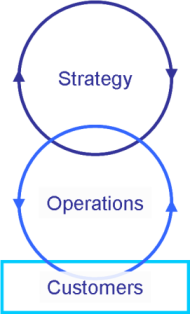
It starts of with a recognition that every organisation does something (operations) for someone (customers). Whether the operation is about providing a service or a product – understanding what you provide to your customers – and their level of satisfaction is clearly important.

Customers and Operations

Just considering these two parts of the organisation can raise a host of powerful questions:

  • Who are our customers?
  • Why do they choose us?
  • What do they love about we do?
  • What do they hate?
  • What do they pay for? What else might they pay for?
  • What do they use? What else might they use?
  • How are our customers changing?
  • How efficient are our operations?
  • How effective are they?
  • Where is there most scope for improvement?
  • Who is responsible for managing operations?
  • Who is responsible for managing customers?
  • How effective is the working relationship between them?

Now let’s add a third component to the organisation that will help us to thrive into the future – a cunning plan – a strategy.

Customers, Operations and Strategy

The strategy loop invests time and money in thinking about what the organisation should be doing today if it is to continue to thrive in the future. In simple terms the operational loop is about earning today’s bottom line. The strategy loop is about ensuring tomorrow’s. In many organisations the strategy loop is almost vanishingly small. Only a few people ever think about it – and acting on it is even rarer! Sometimes ‘strategy’ is done on an annual basis usually tied up with the planning process and budgeting. Often it is done in a top down way – strategy is conceived in the board room or the chief execs office and handed down for implementation. Frequently it does not exist at all!

This strategy loop opens up some further challenging and potentially very valuable questions:

  • What is our strategy?
  • How is it developed?
  • Who is responsible for developing it?
  • How is it communicated?
  • Who is able to shape it?

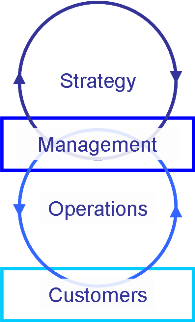
This gives us a fuller picture of the organisation – but it is still not complete. A final component is required to link strategy and operations together. A component to ensure that operations inform strategy and that strategy is put into practice in operations. This component is management.

Customers, Operations, Strategy and Management

This is just about the simplest complete model of an organisation that I can imagine. A manager who is able to develop well founded knowledge of customers, operations, strategy and management is well placed to succeed.

A management team that is able to ensure balanced development of operations, management and strategy – driven by a thorough understanding of customers and their changing needs should be unstoppable.

  • Is management equally effective at developing both operations and strategy?
  • Does management make sure that what happens (operations) takes full account of strategy?
  • Who is responsible for management in your organisation?
  • How could management be improved?

This simple model of the organisation can provide a powerful catalyst for diagnosis and improvement.

Filed Under: Leadership, management Tagged With: change, customers, decision making, Leadership, learning, management, operations, performance improvement, performance management, practical, strategy

The single most costly and common error a manager can make?

February 13, 2008 by admin

Anger - disposition or context?

The ‘fundamental attribution error’ is, in my experience, the single most common and expensive mistake a manager can make.

The fundamental attribution error is our tendency to over-emphasize ‘dispositional’, or ‘personality-based’, explanations for behaviours observed in others while, simultaneously under-emphasizing ‘situational’ explanations. In other words, we tend to assume that someones actions depend on what “kind” of person they are rather than on the contextual forces influencing the person.

So when someone loses their rag in a meeting it is because they are an angry person who can’t control their behaviour and is unprofessional.  When someone cuts us up on the motorway it is because they are a bad driver.  If someone pushes in front of us at Tesco’s it is because they are rude.

This error frequently creeps into our management.  Especially when people are not performing as we would like.  It is convenient to tell ourselves that their behaviour is because of who they are as a person – rather than because of the context in which they are behaving.  This is because we are powerless to change ‘who they are as a person’ so as a manger we need do nothing – we just accept it.  If we start to consider how the context in which they are operating drives the behaviour then we might have to take a bit more responsibility in making changes.  And quite often we find out that the behaviour that we are getting is at its very root caused by the very context that we are paid to manage!

It requires us to resist the temptation to resort to the quick label (they are just lazy/bad/angry/bossy/arrogant/unprofessional).  These labels let us off the hook but leaves the situation unchanged and the behaviour likely to recur.

Instead we should ask ourselves why a rational, sensible and good person would behave that way.  We need to learn to think ‘How Fascinating!’.  We are then forced to consider how context may have driven the behaviour, and what we might be able to do as a manager to change the context.

So for example perhaps the colleague who lost their rag in the meeting is not just Mr Angry – but is really frustrated at being talked over all the time.   In this case we might be able to facilitate the meeting a little more robustly, ensure that everyone gets their voice heard and the angry behaviour is likely to disappear.

By considering these contextual factors we do create ourselves more work (this IS the work of management and should not be shied away from) but we also give ourselves a genuine chance of making things better.  The kinds of contextual factors that cause ‘bad’ behaviours include:

  • lack of skills, judgement or experience (bad driving for example)
  • the behaviours of others (angry outbursts from someone who feels they are continually being interrupted)
  • lack of incentive/disincentive (the bad behaviour is unrecognised and therefore repeated)
  • unchallenged group norms (our meetings always start late)

So learn to recognise and challenge the fundamental attribution error at work.  I guarantee it will make you a much better manager.

Filed Under: Leadership, management Tagged With: change, decision making, Leadership, learning, management, performance improvement, performance management, practical

Why NVQs are not enough

February 12, 2008 by admin

I have just started working with a national charity to improve performance management through an investment in management skills. The HR manager who I am working with said

“All of our managers have been through the NVQ level 3 in Management – but they are still unable or unwilling to recognise and manage under-performers”.

This shows the dangers of pursuing qualifications – rather than pursuing performance. We seem to be trapped in a public policy for vocational education and training that puts qualifications above practice.

We are getting a more qualified workforce – but not necessarily a more able one.

Or am I wrong?

Filed Under: Leadership, management Tagged With: Leadership, learning, management

  • « Previous Page
  • 1
  • …
  • 46
  • 47
  • 48
  • 49
  • 50
  • …
  • 68
  • Next Page »

Recent Posts

  • Hello world!
  • The Challenges of ‘Engaging Community Leaders’
  • Are rich people less honest?
  • 121s – The single most effective tool for improving performance at work?
  • Wendell Berry’s Plan to Save the World

Recent Comments

  • Mike on Some thoughts on Best City outcomes
  • Andy Bagley on Some thoughts on Best City outcomes
  • Mike on Strengthening Bottom Up
  • Jeff Mowatt on Strengthening Bottom Up
  • Jeff Mowatt on Top Down: Bottom Up

Archives

  • November 2018
  • March 2014
  • November 2013
  • October 2013
  • August 2013
  • March 2013
  • February 2013
  • January 2013
  • December 2012
  • September 2012
  • August 2012
  • July 2012
  • June 2012
  • May 2012
  • April 2012
  • March 2012
  • February 2012
  • January 2012
  • December 2011
  • November 2011
  • October 2011
  • September 2011
  • August 2011
  • July 2011
  • June 2011
  • May 2011
  • April 2011
  • March 2011
  • February 2011
  • January 2011
  • December 2010
  • November 2010
  • October 2010
  • September 2010
  • August 2010
  • July 2010
  • June 2010
  • May 2010
  • April 2010
  • March 2010
  • February 2010
  • January 2010
  • December 2009
  • November 2009
  • October 2009
  • September 2009
  • August 2009
  • July 2009
  • June 2009
  • May 2009
  • April 2009
  • March 2009
  • February 2009
  • January 2009
  • December 2008
  • November 2008
  • October 2008
  • September 2008
  • August 2008
  • July 2008
  • June 2008
  • May 2008
  • April 2008
  • March 2008
  • February 2008
  • January 2008
  • December 2007
  • November 2007
  • October 2007
  • September 2007
  • August 2007
  • July 2007
  • June 2007
  • May 2007
  • April 2007

Categories

  • Community
  • Development
  • enterprise
  • entrepreneurship
  • Leadership
  • management
  • Progress School
  • Results Factory
  • Training
  • Uncategorized

Meta

  • Log in
  • Entries feed
  • Comments feed
  • WordPress.org

Copyright © 2026 · Enterprise Pro on Genesis Framework · WordPress · Log in